
The real cost of hiring imported workers in Hong Kong in 2026
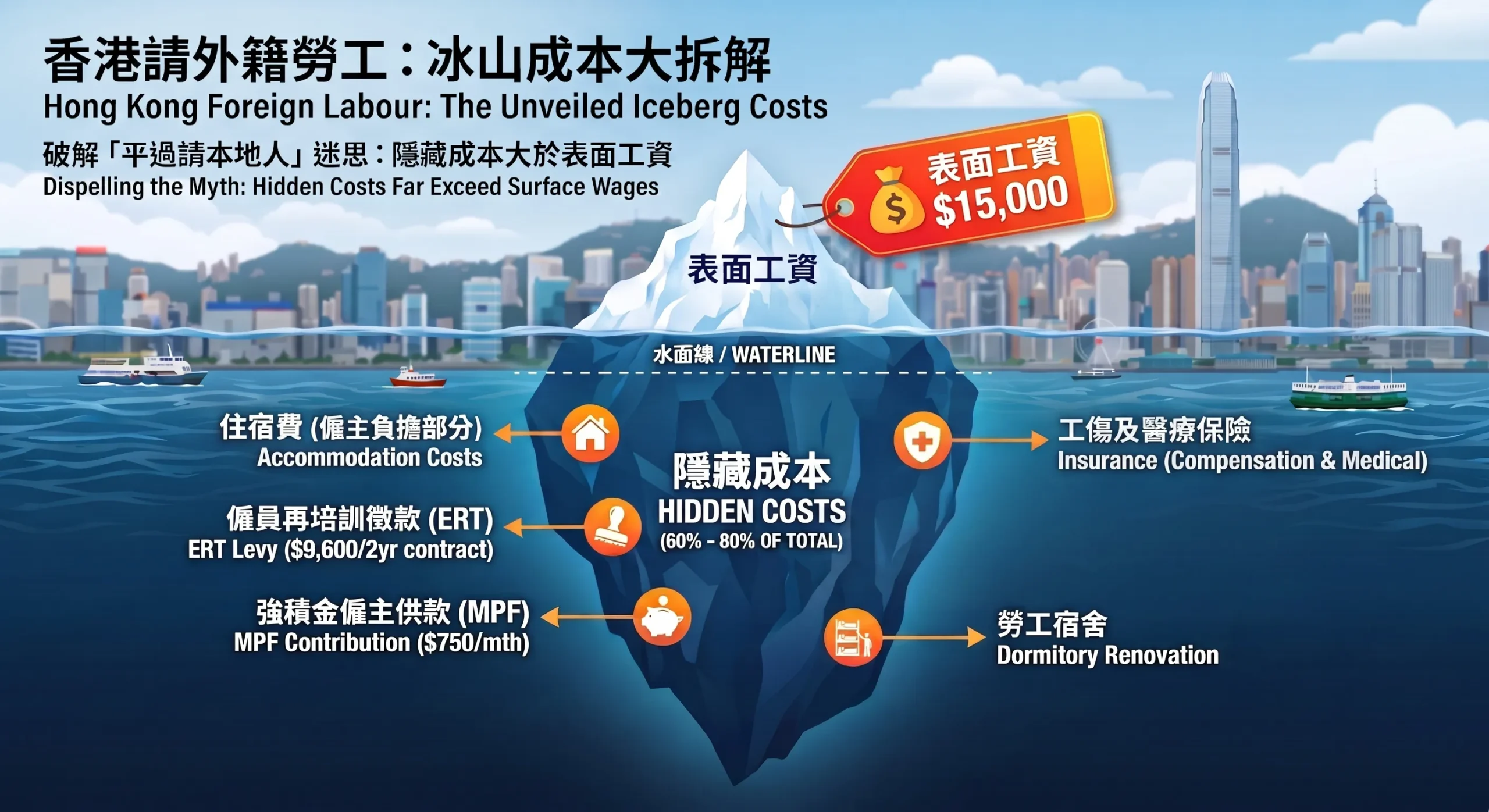
Is hiring imported labour really cheaper than hiring locally? Many Hong Kong owners assume the application costs little, so imported workers must save money on wages. In reality, once you add up every item — the median wage floor, the Employees Retraining levy, housing, employees' compensation insurance and MPF — the total cost of one imported worker can be higher than a local hire.
So why do so many employers still hire through the Enhanced Supplementary Labour Scheme (ESLS)? Because the question is not cheap or expensive; it is whether you can hire anyone at all. In catering, logistics and care, local labour is in structural shortage: even at higher pay, locals may not take the jobs. Imported labour answers 'who will do the work', not 'how to save money'.
With that premise clear, let us count soberly what one imported worker costs in Hong Kong in 2026, item by item, with a full annual budget table.
One: wages — never below the government's median for the post. This is the largest fixed cost. Under ESLS, the wage paid to an imported worker must not be below the median wage the Labour Department publishes for the same local post. The rule exists to stop low-paid imports displacing local workers; in practice it means you cannot lowball — imported pay tracks the local market.
Reference medians for 2026, which are also the minimum you must offer when filing the ESLS application: restaurant waiter or floor staff about HK$15,000 (with the 3:1 local-to-imported ratio for the department); kitchen assistant or dishwashing about HK$13,500; Chinese chef about HK$18,000 to HK$22,000; delivery van driver about HK$18,000 (a valid Hong Kong driving licence required); logistics or handling worker about HK$14,000; care or health worker about HK$14,500 (can apply via the residential care homes special scheme); security guard about HK$15,500; cleaner about HK$12,000.
A note from Labour Services: these medians move. The Labour Department updates them regularly, so confirm the latest figures on its website before filing, and keep 3 to 5 percent of headroom in your budget for updates.
Two: the Employees Retraining levy — a one-off, upfront, non-refundable charge. For each imported worker, the employer pays the levy to the Employees Retraining Authority before the Immigration Department issues the visa, in one lump sum, with no refund in any circumstance — even if the worker resigns early or the contract ends early.
The formula: HK$400 multiplied by the number of contract months, capped at 24 months. A one-year contract costs HK$4,800; a two-year contract HK$9,600. Employers often ask whether early departure earns a refund. It does not: this is explicit in the Employees Retraining Ordinance.
Three: housing — a legal duty that cannot be replaced with cash. This is the hidden cost employers most often miss, and the easiest place to get it wrong. Under Hong Kong law and the standard employment contract, the employer must provide accommodation that meets the standard; a cash allowance instead is not allowed. Dormitories must give each worker at least 5.5 square metres of floor area per person, with bedding, ventilation, lighting, and cooking and bathing facilities.
How much housing cost can be deducted from wages? Under the policy effective from 16 June 2026, the deduction cap rises from 10 percent to 20 percent of wages (excluding overtime), or the actual housing cost, whichever is lower. On a monthly wage of HK$13,500 the cap is HK$2,700; on HK$15,000, HK$3,000; on HK$18,000, HK$3,600.
A practical example: with a dormitory bed renting at about HK$2,800 a month and a HK$15,000 wage (cap HK$3,000), the deduction covers the rent and the employer tops up nothing. Budget also for basic furniture and equipment; planning it early keeps the whole recruitment calmer.
Three housing options exist. First, self-rented dormitories: you lease and fit out units in Hong Kong yourself — most flexible, highest upfront cost. Second, dormitory service providers: a monthly per-head fee to a specialist operator (an add-on service Labour Services offers), sparing you the management. Third, the cross-border option for Mainland workers: workers live in Shenzhen and commute daily — it cuts housing cost sharply, but must meet Labour Department rules and lengthens the commute.
Four: MPF. If the imported worker works in Hong Kong for more than 60 days and is aged 18 to 65, the employer must enrol them in the Mandatory Provident Fund. Employers and employees each contribute 5 percent; the relevant monthly wage ceiling is HK$30,000 (maximum HK$1,500 each) and the floor is HK$7,100, below which the employee is exempt but the employer still contributes. On HK$13,500 the employer pays HK$675 a month; on HK$15,000, HK$750; on HK$18,000, HK$900. Note: non-local workers admitted under talent schemes who remain in Mainland social insurance (basic pension) are exempt from MPF — but most imported workers under ESLS-type routes are not exempt, and the employer must contribute as usual.
Five: insurance. Employees' compensation insurance is a statutory requirement for every imported worker. On top of that, the standard employment contract obliges the employer to provide basic medical coverage, including outpatient, inpatient and emergency dental. Indicative annual costs: employees' compensation about HK$800 to HK$1,500 depending on occupational risk class; medical insurance about HK$1,200 to HK$2,400 covering outpatient and inpatient.
Six: one-off and administrative fees. The Immigration Department visa fee is HK$330 per application.
Seven: a full annual worked example — a restaurant kitchen assistant on HK$15,000 a month with a two-year contract. Insurance runs HK$800 to HK$1,500 a year. The retraining levy is HK$9,600 across the two years. The employer's MPF contribution is 5 percent unless the worker holds continuing Mainland social insurance, in which case the exemption applies. Housing is covered by the 20 percent wage deduction up to actual rent. Wages follow the published median for the post.
The conclusion: a worker whose surface wage is HK$15,000 a month actually costs the employer roughly HK$220,000 to HK$250,000 a year depending on housing and other items — about HK$18,000 to HK$21,000 a month, some 20 to 40 percent above the surface wage. That is why we say hiring imported labour is never just about the wage line.
Every business is different — industry, headcount and housing arrangements all move the final number. Labour Services Company Ltd. offers a free cost assessment: tell us your industry, posts and headcount, and we will compute the most accurate budget and the most cost-effective application route. Message our consultants on WhatsApp for a free assessment of eligibility and cost.
Figures here are as at July 2026; where policy has moved, the announcements of the Labour Department and the Immigration Department prevail.
Frequently asked questions.
Is hiring imported labour cheaper than hiring locally? Not necessarily. Because wages cannot fall below the post median, and the levy, housing and insurance stack on top, the total usually lands close to — sometimes above — a local hire. The value of imported labour is solving genuine vacancies, not saving on cost.
How much housing cost can be deducted from wages? From June 2026, the cap is 20 percent of wages (excluding overtime) or the actual housing cost, whichever is lower; anything above is borne by the employer.
How is the retraining levy calculated, and is it refundable on early departure? HK$400 per contract month, capped at 24 months, paid in one lump sum before the visa is issued. It is non-refundable in all circumstances, including early resignation or early termination.
How much is the employer's MPF contribution? 5 percent of the worker's monthly wage, capped at HK$1,500 a month. Most Mainland imported workers are not exempt, and the employer must contribute as normal.
Who pays medical costs? Under the standard employment contract the employer must provide basic medical care including outpatient and inpatient; medical insurance covering these is the practical way to transfer the risk.
For the questions other owners ask most — staffing ratios, how long local recruitment takes — see the employer FAQ page.