
Editorial: Importing labour is not for suppressing wages — local employment must be protected | Ming Pao
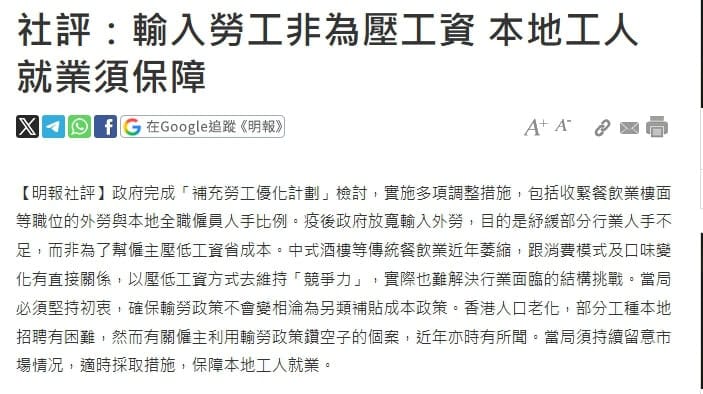
[Ming Pao editorial] The government has completed its ESLS review with multiple adjustments, including tighter ratios between imported workers and local full-time staff for catering front-of-house and similar positions. The post-pandemic relaxation of labour importation aimed to ease shortages in certain industries — not to help employers suppress wages and cut costs. The shrinkage of traditional Chinese dining in recent years relates directly to changing consumption patterns and tastes; trying to stay "competitive" by holding down wages hardly solves the industry's structural challenges. The authorities must hold to the original intent and ensure the importation policy doesn't become a disguised cost-subsidy policy. Hong Kong's population is ageing and some trades genuinely struggle to recruit locally, yet cases of employers gaming the scheme have surfaced repeatedly in recent years. The government must keep watching the market and act in time to protect local employment.
Further refinement against gaming
Post-pandemic recovery in 2023 brought staffing laments across industries. That September, the government optimised the Supplementary Labour Scheme, opening importation for 26 previously barred non-skilled/low-skilled categories (the "26 categories") — salespeople, waiters, demolition workers and more. Catering became the top applicant, importing mainly front-of-house waiters and junior cooks. Employers must recruit locally for four weeks without success, and observe the 2:1 ratio of local full-time staff to imported workers.
The Labour Department stresses it vets each application's employment terms, ensuring reasonable duties and pay at the relevant monthly median — yet some employers still game the system. Take the "4-week local-first recruitment": vague or misleading adverts, or hostile recruitment conditions, can ensure no locals apply regardless of duration. On ratios, unions have caught employers computing the 2:1 ratio company-wide while staffing the frontline entirely with imported workers. Recent complaints to the department — many involving catering — include false information about local hiring and unauthorised recruitment terms.
Four key review outcomes
The review, published this week, has four emphases: first, given ageing and genuine local recruitment difficulty in some trades, the scheme becomes permanent, keeping the 26 categories; second, tiered approval — Tier 1 keeps current rules, Tier 2 faces stricter limits including a 3:1 local-to-imported ratio computed per department, plus six weeks of open local recruitment; third, heavier administrative sanctions for serious violators — up to five years out of the scheme; fourth, flexibilities for employers including a higher housing-deduction cap.
Tiered approval indirectly acknowledges the gaming problem. Putting catering's junior cooks, beverage preparers and other production roles, plus waiters, floor captains and cashiers, into Tier 2 sharpens the targeting further.
"Not low offers, just unwanted jobs"?
Catering representatives say the new measures add hiring pressure and that difficulty reflects young people avoiding traditional restaurants rather than low pay — culinary graduates preferring hotel dining. But note: floor-waiter roles were never primarily aimed at young people; they historically employ breadwinners from lower-income groups. Since the scheme began, unions have documented restaurants replacing locals and part-timers with imported workers — clearly not the policy's intent.
Innovate, don't lean on imported labour to cut costs
Local catering's annual revenue is around HK$110 billion — still below pre-pandemic levels. Traditional restaurants keep closing, yet takeaway, Japanese, Korean and Southeast Asian restaurants are doing well — many expanding against the trend with distinctive, value-for-money food popular with younger diners. In short, local catering is reshuffling: the traditional Chinese pillar faces structural contraction from northbound consumption and changing tastes, and must innovate to attract customers. Relying on imported labour to suppress wage costs — bluntly — only prolongs survival without building real competitiveness.
Catering's mismatch is severe: unemployment touched 6.4% while many veteran chefs and floor staff lost jobs; yet over the past nine months, 4,000 catering vacancies drew only 700 local applicants — 230 hired, just 12 started. One may reasonably suspect a gap between jobseekers' expectations and employers' offers; the new arrangements should in theory improve matching.
Watch the housing-deduction change
Raising the housing-deduction cap is another significant move. Employers providing imported-worker housing may deduct housing fees from wages — now up from 10% to 20%. The department explains that with typical monthly wages of HK$15,000–18,000, the 10% deduction (HK$1,500–1,800) leaves employers "little choice" in finding suitable housing; a higher cap should motivate better accommodation. Of course, the likelier real-world outcome: housing unchanged, with employers pocketing most of the extra deduction — effectively an indirect cut in import costs. Policies breed counter-moves; the authorities must keep watching the effects on local hiring and employers' calculations alike.
Original article: https://news.mingpao.com/pns/社評/article/20260617/s00003/1781633120630/社評-輸入勞工非為壓工資-本地工人就業須保障
Related
- 2026年6月新制懶人包:補充勞工優化計劃四大改動
- Imported labour | Hui Tak-sum: catering unemployment reflects structural change — new mechanism aids matching | HK01
- Imported labour | Housing-fee deduction cap relaxed to 20% of wages — catering industry fears it will dent workers' willingness to come | i-CABLE
- Policy & news hub
- ESLS process & fees